Government Strengthens Drug Demand Reduction, Expands De-Addiction Services and Streamlines Support Under Centrally Sponsored Schemes: MoS for Social Justice and Empowerment Shri B. L. Verma in Written Reply in Lok Sabha
More Than 29.68 Crore Citizens Reached Under Nasha Mukt Bharat Abhiyaan Through Nationwide Awareness Campaigns

The Ministry of Social Justice and Empowerment is continuously strengthening the implementation of Centrally Sponsored Schemes to ensure timely financial assistance, enhanced transparency and improved delivery of services in the areas of drug demand reduction, rehabilitation and social justice. The Ministry has introduced measures to simplify fund release procedures, expand de-addiction infrastructure and enhance access to rehabilitation services across the country.
This information was given by Minister of State for Social Justice and Empowerment Shri B. L. Verma in a written reply to a number of questions put forth by Member of Parliament Smt Pratima Mondal
The Minister informed the House that the Department has established a stringent monitoring mechanism to ensure timely processing of proposals and release of funds under various Centrally Sponsored Schemes. A revised Standard Operating Procedure (SOP) has also been introduced to simplify the release of grants to partner NGOs implementing schemes such as the National Action Plan for Drug Demand Reduction (NAPDDR) and the Atal Vayo Abhyuday Yojana (AVYAY) by reducing documentation requirements and improving administrative efficiency.
Highlighting the Government’s efforts to tackle substance abuse, Shri Verma stated that the Ministry is implementing a comprehensive and evidence-based strategy under the National Action Plan for Drug Demand Reduction (NAPDDR). The strategy is based on the findings of the first National Survey on the Extent and Pattern of Substance Use in India conducted by National Drug Dependence Treatment Centre (NDDTC) at AIIMS, New Delhi.
The survey estimates that alcohol remains the most widely consumed substance among adults (18 to 75 years) with approximately 15.10 crore users, followed by 2.90 crore cannabis users, 1.90 crore opioid users, 1.10 crore sedative users and 60 lakh inhalant users in this category. Among children and adolescents (10 to 17 years), the survey estimates around 40 lakh opioid users, 30 lakh alcohol users, 30 lakh inhalant users and 20 lakh cannabis users, underscoring the need for sustained awareness, prevention and treatment initiatives.
The Minister further informed that under NAPDDR, the Ministry provides financial assistance to State Governments, Union Territories, NGOs and Government hospitals for preventive education, awareness generation, counselling, treatment and rehabilitation. At present, the Ministry supports 344 Integrated Rehabilitation Centres for Addicts (IRCAs), 45 Community-based Peer Led Interventions (CPLIs), 76 Outreach and Drop-in Centres (ODICs), 145 District De-Addiction Centres (DDACs) and 155 Addiction Treatment Facilities (ATFs) across the country.
The written reply further stated that the Nasha Mukt Bharat Abhiyaan (NMBA), launched on 15 August 2020 and expanded to all districts in August 2023, has emerged as one of the world’s largest awareness campaigns against substance abuse.
As on date, the campaign has reached more than 29.68 crore citizens, including over 11.43 crore youth and 8.05 crore women, through nationwide awareness activities. More than 1.17 lakh Nasha Mukti Mitras have also joined the campaign to strengthen community participation. In addition, over 28.29 lakh persons have been treated and rehabilitated besides undertaking outreach activities in 21.73 lakh educational institutions across the country.
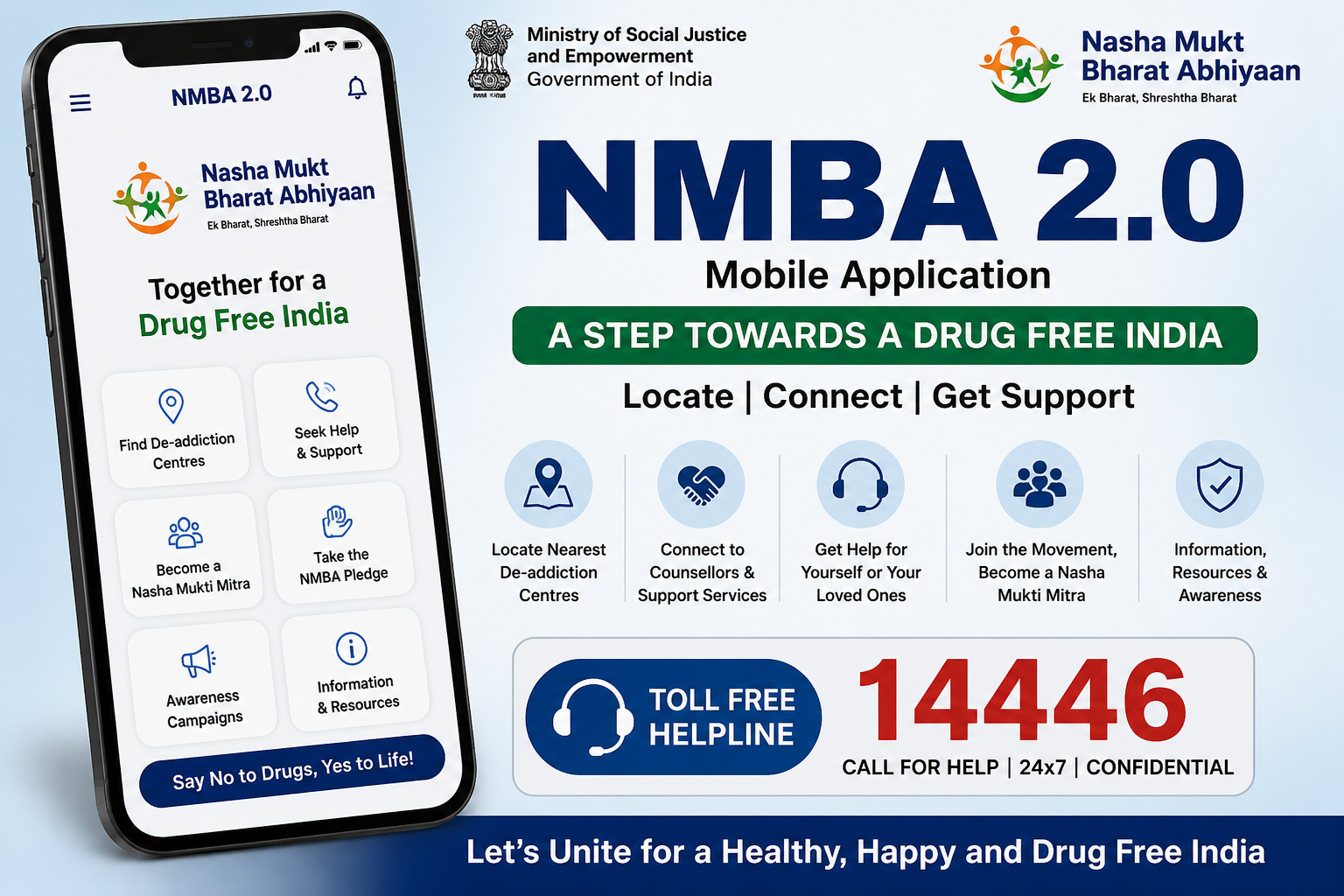
To improve accessibility to treatment services, the Ministry has launched the NMBA 2.0 Mobile Application, enabling citizens to locate the nearest de-addiction centre. During 2024-25, 55 new District De-Addiction Centres (DDACs) were approved in GAP districts, while 21 additional DDACs were established during 2025-26, further expanding the country’s de-addiction infrastructure.
The Minister also informed the House that independent third-party evaluations conducted by M/s Development & Research Services Pvt. Ltd. in December 2024 and NITI Aayog in 2025 have found that the National Action Plan for Drug Demand Reduction has made significant progress in strengthening institutional capacity and creating awareness against substance abuse across the country.
The Government continues to strengthen its commitment towards a drug-free and socially inclusive India by expanding rehabilitation infrastructure, enhancing preventive interventions, simplifying implementation procedures and ensuring efficient delivery of Centrally Sponsored Schemes. Through sustained community participation, improved governance and technology-enabled service delivery, the Ministry remains committed to protecting vulnerable communities and promoting social justice for all.