JMI hosts National Conference on Heart Disease Research

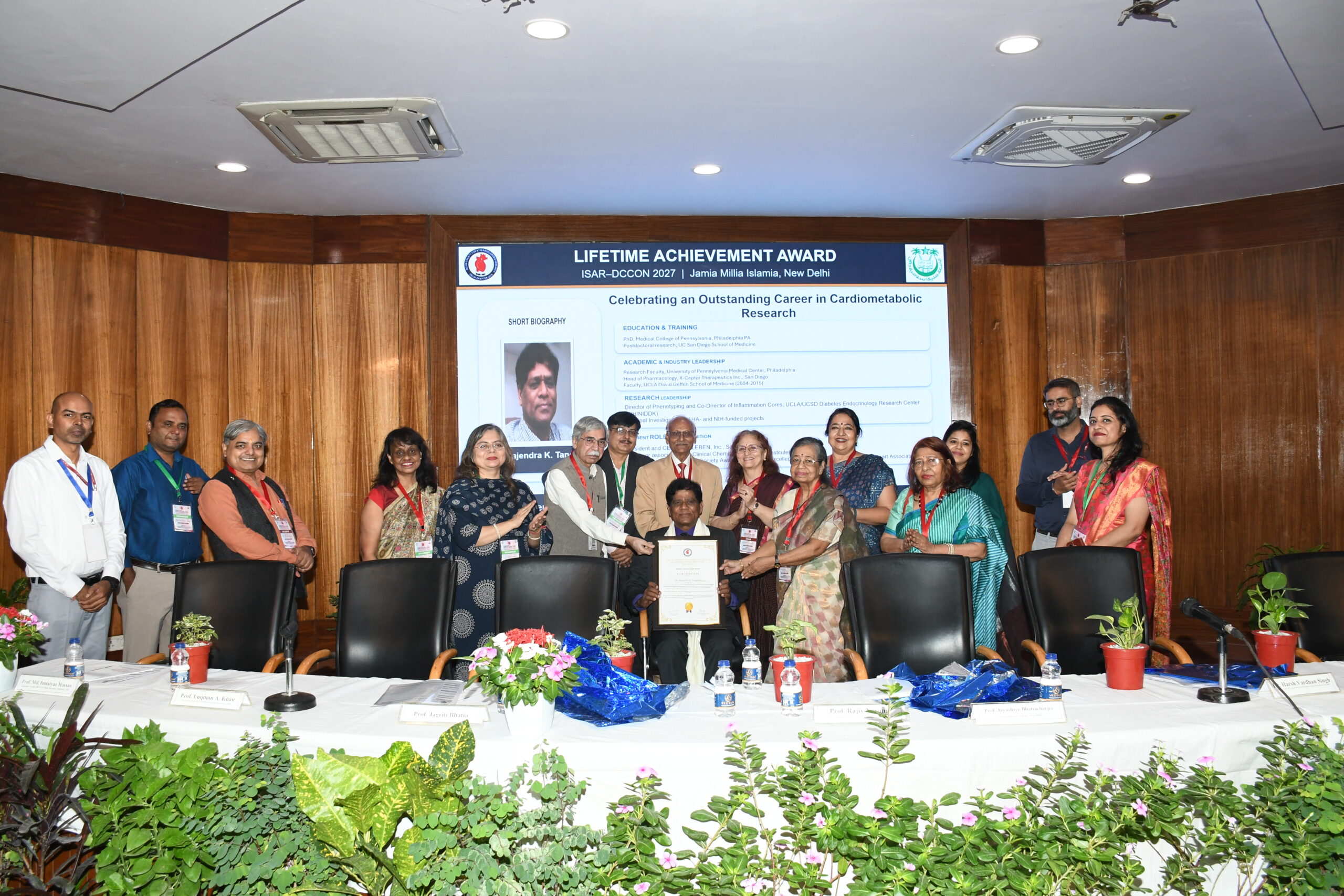
The 11th Annual Conference of the Indian Society for Atherosclerosis Research – Delhi Chapter (ISAR–DCCON 2026) was held on October 10, 2026 at the Auditorium of the Faculty of Engineering & Technology, Jamia Millia Islamia (JMI). The conference was organized by the DDU KAUSHAL Kendra (DDUKK), Faculty of Life Sciences, JMI, together with the Delhi Chapter of the Indian Society for Atherosclerosis Research (ISAR DC).
Atherosclerosis is the build-up of fatty deposits, or plaque, inside the arteries. It is the main cause of heart attacks and strokes, and in India it often strikes people at a younger age than in Western countries. The theme of this year’s conference was “Bridging the Gap: From Molecular Mechanisms to Precision Management of Atherosclerosis”, bringing together doctors, scientists and students to discuss how laboratory discoveries can lead to better, more personalized care for patients.
Around 400 delegates, including senior clinicians, researchers, faculty members and students from institutions across Delhi-NCR and beyond, took part in the day long programme. The conference was inaugurated by the Chief Guest, Prof. Jayashree Bhattacharjee, former Director, Vardhman Mahavir Medical College (VMMC) and Safdarjung Hospital, New Delhi. In her address, she emphasized the need for early detection and for research that reaches patients.
Prof. Md. Imtaiyaz Hassan, Director, DDU KAUSHAL Kendra, JMI and Convener of the conference, welcomed the guests and delegates. Prof. Luqman A. Khan, Dean, Faculty of Life Sciences, JMI, gave an overview of the conference. Prof. Jagriti Bhatia, President, ISAR Delhi Chapter, delivered the presidential address, and Dr. Harsh Vardhan Singh, Secretary, ISAR Delhi Chapter, spoke about the Society and its work in promoting research on heart and blood vessel disease. The inaugural session ended with a vote of thanks by Prof. Mohammad Zahid Ashraf, Coordinator of the conference.
A highlight of the conference was the presentation of the ISAR–DC Lifetime Achievement Award to Dr. Rajendra K. Tangirala of the Karolinska Institutet, Stockholm, Sweden, for his outstanding contribution to atherosclerosis research. Over three decades, Dr. Tangirala’s work has focused on finding the molecular targets behind plaque build-up and on developing new treatments. In his keynote address, he explained how cholesterol, oxidative stress and inflammation work together to drive the disease.
In the Plenary Lecture, Prof. Rajiv Narang, Professor and Head, Department of Cardiology, AIIMS, New Delhi, described how heart treatment has moved beyond simply opening blocked arteries. Doctors now use pressure measurements and imaging inside the arteries to decide which blockages need a stent, and combine this with strong cholesterol-lowering and follow-up care suited to each patient.
In the keynote addresses, Dr. Shantanu Sengupta, Chief Scientist, CSIR IGIB, presented findings from Phenome India, a health study of more than 10,000 people across 24 cities. He showed that vitamin B12 levels are linked to cholesterol patterns differently in men and women, and that a father’s B12 status may affect the health of his children. Dr. Amitabh Yaduvanshi, Chief of Cardiology Services, Holy Family Hospital, explained how modern imaging can now spot “vulnerable” plaques that are likely to burst and cause a heart attack, so that they can be treated before the event happens.
The invited lectures covered a wide range of topics. Dr. Preeti Gahlan of Fortis Hospital spoke on blood tests that measure inflammation and harmful lipids to judge a patient’s risk more precisely. Dr. Arockiasamy Arulandu of ICGEB described new drug molecules that block LOX-1, a receptor that helps “bad” cholesterol damage blood vessels, which reduced plaque in early laboratory studies. Dr. Archna Singh of AIIMS presented genetic findings in Indian patients with high triglycerides, including several gene changes not reported before. Dr. Saran Kumar of IIT Delhi showed how protecting the smallest blood vessels may keep the heart and other organs healthy with age, and Dr. Rudra Nayan Das of Shiv Nadar University presented zebrafish models for studying abnormal blood-vessel growth and screening new drugs.
In a Special Lecture, Dr. Balachandar Venkatesan, Senior Scientist and Member Secretary – Health Science & Ayurvedic Biology, Anusandhan National Research Foundation (ANRF), guided young researchers on national research funding. He explained ANRF schemes such as the Advanced Research Grant, the Prime Minister Early Career Research Grant, the Mission for Advancement in High-Impact Areas (MAHA) and Partnerships for Accelerated Innovation and Research (PAIR), and shared practical tips on writing successful research proposals.
The Vision and Guidelines Lecture Series brought together three senior experts. Prof. Jasvinder K. Gambhir spoke on lipoprotein(a), an inherited risk factor for heart disease. Prof. Harmeet Singh Rehan of Lady Hardinge Medical College explained why cholesterol problems in Indians are different from those in Western populations and need an India-specific approach to treatment. Prof. Shridhar Dwivedi, National Heart institute, spoke on how a mother’s health before and during pregnancy can shape a child’s risk of heart disease later in life, and called for prevention to begin early.
The Young Investigators’ Forum gave students and early-career researchers a platform to present their work. Young scientists presented 16 oral and 54 poster presentations on topics ranging from new biomarkers and genetic studies to drug discovery and patient-based clinical research. Their work was evaluated by a panel of expert judges, and prizes for the Best Oral and Best Poster Presentations were given at the valedictory session. The sessions were chaired by senior experts from AIIMS, VMMC, LHMC, UCMS, Sir Ganga Ram Hospital, JNU, Jamia Hamdard, CSIR IGIB, DRDO and JMI, who guided lively discussions throughout the day.
The conference concluded with the valedictory session, the presentation of awards and the induction of new office bearers of ISAR Delhi Chapter. The organizers thanked all speakers, chairs, judges, delegates and students for making the conference a success, despite the traffic restrictions in the city on the day.