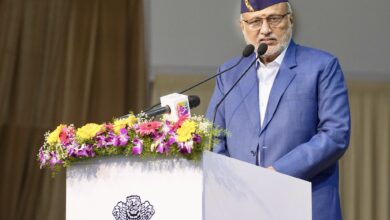
Prof V. N. Rajasekharan Pillai: An Institution Builder, Scientific Visionary and Architect of India’s Knowledge Future – Prof. Divya Tanwar


India’s journey towards becoming a developed nation by 2047 demands not merely economic expansion and technological advancement, but a profound transformation of its educational institutions, research ecosystem and intellectual capital. At the heart of this national aspiration stands the invaluable contribution of distinguished academicians, scientists and institution-builders. Professor V. N. Rajasekharan Pillai, former Chairman of the University Grants Commission (UGC), is one such eminent personality whose professional journey reflects an extraordinary commitment to education, scientific excellence and nation-building.
With a career spanning more than five decades, Professor Pillai represents a rare combination of an accomplished scientist, visionary educationist, academic administrator and public policy contributor. His distinguished association with some of India’s most significant educational and research institutions has enabled him to contribute to the development of higher education at multiple levels.
His leadership journey includes some of the most influential positions in Indian academia, including Vice-Chairman and Chairman of the UGC, Executive Director of the National Assessment and Accreditation Council (NAAC), Vice-Chancellor of Indira Gandhi National Open University (IGNOU), Mahatma Gandhi University and Cochin University of Science and Technology. He has also contributed to the Kerala State Council for Science, Technology and Environment, bringing together academic vision, scientific administration and public policy.
What makes Professor V N R Pillai particularly distinguished is that his contribution extends far beyond administrative leadership. As an internationally recognised polymer scientist, he has made significant contributions to chemical sciences, particularly polymer science, biopolymers and peptides. His research career includes more than 200 scholarly publications and the mentorship of over 65 doctoral and post-doctoral researchers across institutions in India and Europe. His academic engagements with the Universities of Tübingen, Mainz and Lausanne further reflect his international intellectual standing. His election as a Fellow of the Indian Academy of Sciences is another testament to his scientific distinction.
Equally significant is his contribution to the evolution of India’s higher education framework. His association with NAAC and UGC placed him at the centre of important national discussions on institutional accreditation, academic standards, university governance and educational quality. His engagement with UNESCO’s higher education policy initiatives also reflects India’s participation in global conversations on the future of education.
In the contemporary context, when India is aspiring to realise the vision of Viksit Bharat @2047, Professor Pillai’s educational philosophy assumes particular relevance. A developed nation cannot be built merely through infrastructure, industrialisation or digital expansion; it requires universities that nurture independent thinking, scientific curiosity, innovation, ethical leadership and a spirit of social responsibility.
His advocacy of multidisciplinary education, fundamental research and stronger academic foundations resonates with the transformative objectives of the National Education Policy 2020. He has emphasised the importance of strengthening undergraduate and postgraduate education, improving research opportunities in affiliated colleges and universities, and ensuring that excessive vocational specialisation does not undermine the fundamental purpose of universities. Such perspectives are essential for creating a knowledge-driven economy and preparing India’s young generation for global challenges.
His vision also underlines the importance of connecting scientific research with societal needs. India must create an educational ecosystem in which innovation reaches industry, research contributes to national development, and universities become centres of solutions to real-world challenges. Equitable access, academic quality and institutional autonomy must remain integral to this transformation.
Beyond professional achievements, Professor Pillai’s journey reflects the values of intellectual discipline, academic integrity, institutional commitment and lifelong learning. His ability to work across scientific research, university administration, national policy and international academic platforms makes him an inspiring example for emerging scholars and educational leaders.
I regard Prof V. N. Rajasekharan Pillai as an important voice in India’s continuing educational transformation. His experience, scholarship and institutional wisdom offer valuable guidance at a time when the country needs visionary leadership to connect education with national aspirations.
Ultimately, Viksit Bharat 2047 will be built not only by economic powerhouses but also by enlightened minds, empowered universities, pioneering researchers and institutions committed to excellence. Professor Pillai’s distinguished contribution to India’s educational and scientific landscape deserves recognition as part of this larger national journey.
(Author is Professor in Cyber Security and Chairperson of Divey Foundation New Delhi)