The Darkest Night of Indian Democracy: Revisiting the Emergency of 1975 – Prof. Jasim Mohammad

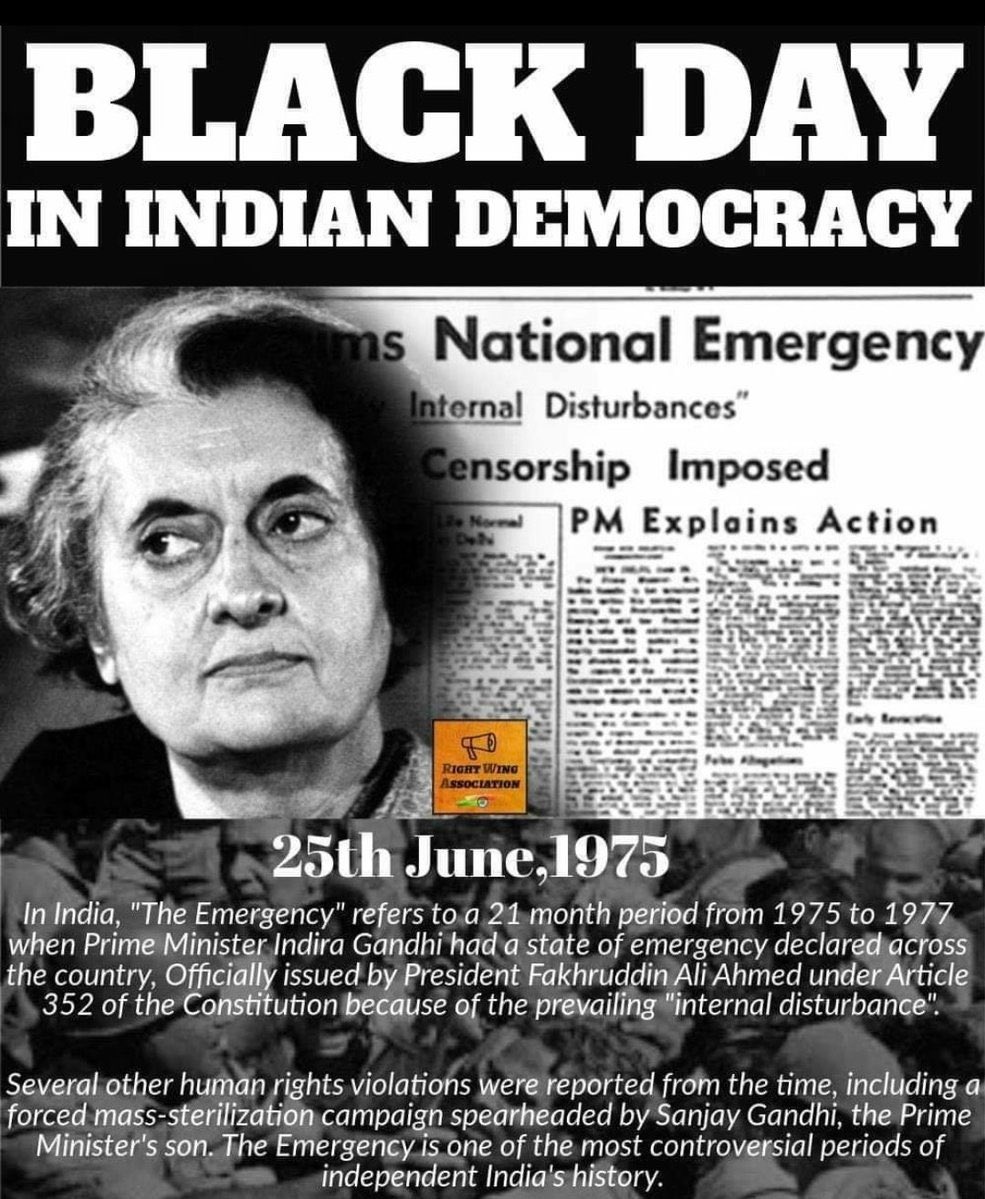
The proclamation of the Internal Emergency on the morning of 26 June 1975 remains one of the most controversial and deeply debated chapters in the constitutional and political history of independent India. For twenty-one months, from June 1975 until March 1977, the world’s largest democracy witnessed an unprecedented concentration of executive power, widespread suspension of civil liberties, press censorship, mass arrests of political opponents, and serious allegations of abuse of state authority. Regardless of political affiliation, the Emergency continues to serve as a profound reminder of how democratic institutions can be weakened when constitutional safeguards are subordinated to executive power.
The immediate political backdrop was the judgment of the Allahabad High Court on 12 June 1975, which found Prime Minister Indira Gandhi guilty of electoral malpractice in her 1971 Lok Sabha election and declared her election void. The verdict threatened her continuation in office and intensified nationwide protests led by veteran socialist leader Jayaprakash Narayan, who demanded her resignation and called for peaceful civil resistance. Rather than stepping down or awaiting a final judicial resolution, the government advised President Fakhruddin Ali Ahmed to proclaim a national Emergency under Article 352, citing “internal disturbance” as the constitutional basis.
The declaration fundamentally altered India’s democratic landscape. Overnight, constitutional freedoms that citizens had taken for granted were curtailed. Preventive detention laws were invoked extensively, thousands of political leaders, activists, journalists, trade unionists, students, and social workers were arrested, and normal democratic dissent was virtually criminalized. Elections were postponed, opposition politics was severely restricted, and executive authority expanded to levels rarely witnessed in democratic societies. Estimates indicate that well over one hundred thousand people were detained during the Emergency under various preventive detention laws.
Perhaps the most visible casualty of the Emergency was the freedom of the press. Beginning on 26 June 1975, newspapers across the country were subjected to pre-publication censorship. Editors were required to submit reports, editorials, political commentary, and even photographs for government approval before publication. Critical reporting disappeared from newspapers not because criticism had vanished, but because censorship had become institutionalized. Many journalists were intimidated, some were detained, and newspapers that resisted government directives faced severe consequences. The famous description of the period—that when newspapers were asked to bend, many chose to crawl—continues to symbolize one of the darkest moments in the history of Indian journalism.
The judiciary too found itself under extraordinary pressure. One of the most criticized legal developments was the Supreme Court’s decision in the ADM Jabalpur (Habeas Corpus) case, where the majority held that during the Emergency citizens could not effectively enforce their right to personal liberty through habeas corpus petitions. The judgment has since been widely regarded as one of the lowest points in India’s constitutional jurisprudence and has been effectively repudiated in later constitutional thinking. It demonstrated how fragile constitutional guarantees become when institutions fail to uphold individual liberty during times of executive excess.
The Emergency also witnessed constitutional amendments that significantly expanded executive authority. The Thirty-Eighth Amendment restricted judicial review of Emergency proclamations, while the Thirty-Ninth Amendment sought to place the election of the Prime Minister and certain high constitutional offices beyond judicial scrutiny. These measures were widely viewed as attempts to shield political authority from constitutional accountability rather than strengthen democratic governance.
No discussion of the Emergency can ignore the controversial role attributed to Sanjay Gandhi, who, despite holding no elected constitutional office, emerged as an influential political figure during this period. His five-point programme became associated with aggressive administrative campaigns, particularly compulsory or coercive sterilization drives and large-scale urban demolition projects. Numerous reports documented allegations that ordinary citizens, especially the poor and marginalized, faced coercion, intimidation, or administrative pressure in implementing these programmes. These actions left lasting scars on public memory and remain among the most criticized aspects of the Emergency.
The forced sterilization campaign became synonymous with state excess. While family planning itself was a legitimate public policy objective, its implementation in several regions crossed ethical and legal boundaries. Reports documented cases where consent was absent or obtained under duress. Government employees allegedly faced sterilization targets, and vulnerable sections of society disproportionately bore the burden of these coercive measures. Public confidence in family planning programmes suffered for years as a consequence.
The Shah Commission, established after the Emergency by the Janata Party government under Justice J.C. Shah, conducted a detailed inquiry into the events of 1975–77. Its findings were deeply critical of the conduct of the government and administration during the Emergency. The Commission concluded that the Emergency was not justified by the prevailing circumstances, found extensive evidence of misuse of preventive detention laws, abuse of police powers, suppression of press freedom, manipulation of administrative machinery, and violations of civil liberties. It also criticized the concentration of decision-making within a small circle of political authority and held that many officials abandoned constitutional responsibility in favour of unquestioning political obedience.
One of the most enduring criticisms directed at Indira Gandhi concerns not merely the declaration of the Emergency itself but the concentration of political authority in the Prime Minister’s Office. Democratic institutions exist precisely to prevent excessive personalisation of power. During the Emergency, Parliament functioned with diminished independence, the opposition was largely silenced, civil servants frequently acted under political pressure, and constitutional checks and balances weakened considerably. Whether viewed through a constitutional, historical, or democratic lens, this concentration of authority remains a cautionary example of how even established democracies can become vulnerable when institutional independence erodes.
It is equally important to recognise that responsibility did not rest solely with political leadership. Sections of the bureaucracy, law enforcement agencies, and even parts of the media and judiciary failed to resist unconstitutional excesses. Democratic erosion rarely occurs because of one individual alone; it succeeds when institutions entrusted with safeguarding constitutional values choose compliance over courage. The Emergency illustrated how institutional weakness can amplify executive overreach.
The people of India ultimately delivered the strongest democratic verdict. In January 1977, elections were announced, and in March the electorate decisively voted the Congress government out of power. The peaceful transfer of power to the Janata Party demonstrated that despite twenty-one months of authoritarian rule, democratic consciousness remained deeply rooted among Indian citizens. The election became a historic reaffirmation that sovereignty ultimately belongs to the people, not to any government or political leader.
The constitutional response after the Emergency was equally significant. The Forty-Fourth Constitutional Amendment introduced important safeguards by replacing the vague expression “internal disturbance” with the narrower term “armed rebellion” as a ground for proclaiming a national Emergency. It also strengthened protections for fundamental rights, ensuring that certain core rights could not be suspended in the same manner again. These reforms reflected a national determination that the mistakes of 1975 should never be repeated.
Half a century later, the Emergency continues to evoke strong political emotions, yet its enduring lesson transcends party politics. It is a reminder that democracy cannot survive merely through periodic elections. It requires an independent judiciary, a fearless press, accountable governments, a vigilant civil society, and citizens willing to defend constitutional freedoms irrespective of which political party is in power. Historical memory loses its value if it is reduced to partisan rhetoric instead of becoming a permanent constitutional warning.
The Emergency should therefore be remembered as a constitutional cautionary tale. History records remarkable achievements and grave mistakes alike, and democratic maturity requires acknowledging both. The suspension of civil liberties, censorship of the press, imprisonment of political opponents, coercive administrative actions, and concentration of executive authority during the Emergency remain enduring reminders that no leader, however popular, should ever be placed above constitutional accountability. The greatest tribute to those who suffered during that period is not merely to remember the Emergency, but to ensure that the institutions of Indian democracy remain strong enough that such a chapter is never repeated.

(Author is Chairman of Centre for NaMo Studies (CNMS) Email : profjasimmd@gmail.com)