In this era of Artificial Intelligence, emphasis must be placed on the importance of value-based education — Dr. Atul Kothari
The Centre for Namo Studies organized the Artificial Intelligence Education Summit 2026 in New Delhi, under the joint aegis of NCPUL and ICSSR.

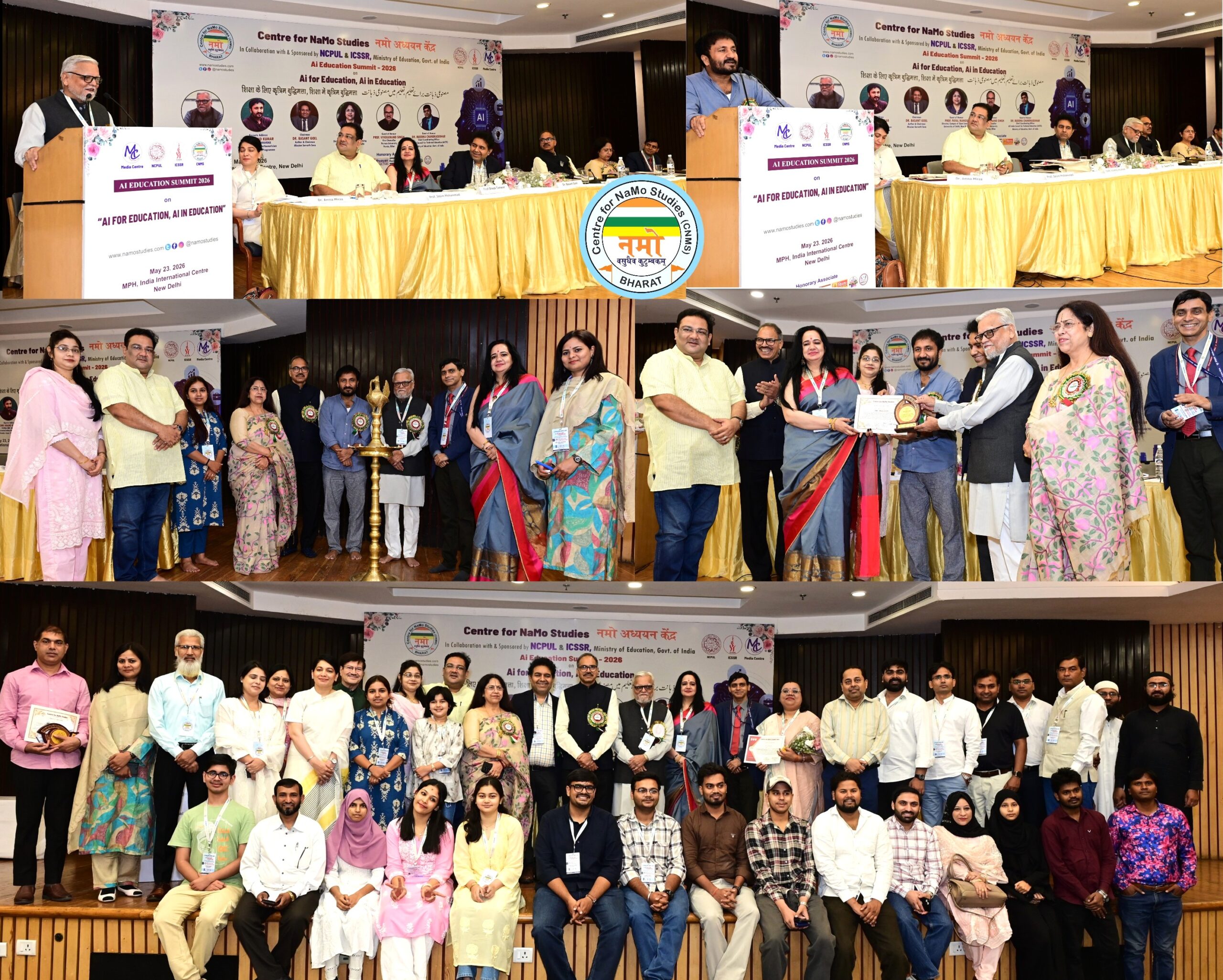 TNN News : The Centre for NaMo Studies (CNMS), in collaboration with NCPUL & Media Centre and sponsored by ICSSR, Ministry of Education, Government of India, successfully organised the AI Education Summit 2026 on the theme “AI for Education, AI in Education” at the India International Centre, New Delhi. In his welcome address, Prof. Jasim Mohammad from the Centre for NaMo Studies expressed his heartfelt gratitude to all the distinguished guests, scholars, and participants, and described this national-level programme on Artificial Intelligence (AI) as the beginning of a meaningful academic and intellectual movement in the field of AI and education.
The summit was graced by Dr. Atul Kothari Ji, National Secretary, Shiksha Sanskriti Utthan Nyas, as the Chief Guest. Addressing the gathering, he emphasised the importance of value-based education in the era of Artificial Intelligence. He stated that AI should become a tool for strengthening human wisdom, ethics, and national development rather than replacing human consciousness.
Delivering the keynote address, Padma Shri Awardee Shri Anand Kumar, founder of Super 30, spoke about the transformative role of Artificial Intelligence in education and equal learning opportunities. He highlighted how technology can support students from economically weaker sections and rural backgrounds if used with proper vision and accessibility.
The summit was chaired by Dr. Basant Goel , Author and Chairman of Mission Sarvath Seva, who presided over the programme and stressed the need for responsible and inclusive use of AI in the education sector. He stated that AI must work for humanity, social harmony, and educational empowerment.
Among the distinguished Guests of Honour, Prof. Vivekanand Singh Ji, Vice Chancellor of Purnea University, Bihar, spoke on the growing role of universities in adapting to AI-driven academic environments and preparing students for future challenges.
Dr. Buddha Chandrasekhar, CCO, AICTE, highlighted various initiatives being undertaken to integrate Artificial Intelligence into higher education and skill development frameworks across India. He encouraged institutions to embrace innovation and interdisciplinary learning.
Prof. Payal Mago Ji, Director, Campus of Open Learning, DU, discussed the importance of digital inclusion, accessible learning platforms, and innovative teaching methodologies in the changing educational landscape.
The organisers stated that the summit aimed to create meaningful dialogue on the future of education in the age of Artificial Intelligence while connecting Indian knowledge traditions with modern technological advancements.
The programme commenced with the Technical Session, the session was chaired by Prof. Ihtiram Raza Khan, Adjunct Professor, Jamia Hamdard. The welcome address was delivered by Jawaid Rahmani, while the introductory remarks were presented by Dr. Deeba, moderated by Ms. Tushita Bhandari.
The technical session was further guided by distinguished Co-Chairs including Dr. Amrita Sastry, Associate Professor, DU; Dr. J. P. Singh, Assistant Professor, DU; and Dr. Aparna Singh, BHU, Varanasi.
During the technical session, Prof. Divya Rashmi Tanwar presented her research paper; another paper presentation was delivered by Shahi Raza Khan and Vanshit Mehta on the topic “Media Convergence and Indian Knowledge System: Transforming Traditional Wisdom into Digital Experiences.”
According to Firoz Bakht Ahmed, former Chancellor MANUU, the seminar on AI and education, the best treatises proved that AI is very important but it does have its loopholes and there should be a foolproof and thorough AI in the Indian context.
The summit concluded with a vote of thanks by Trustee Dr Daulat Ram and appreciation to all guests, speakers, researchers, participants, and collaborating institutions for making the summit a grand success.