Validity of Umbrella Laws Governing Private Universities Challenged Before Supreme Court

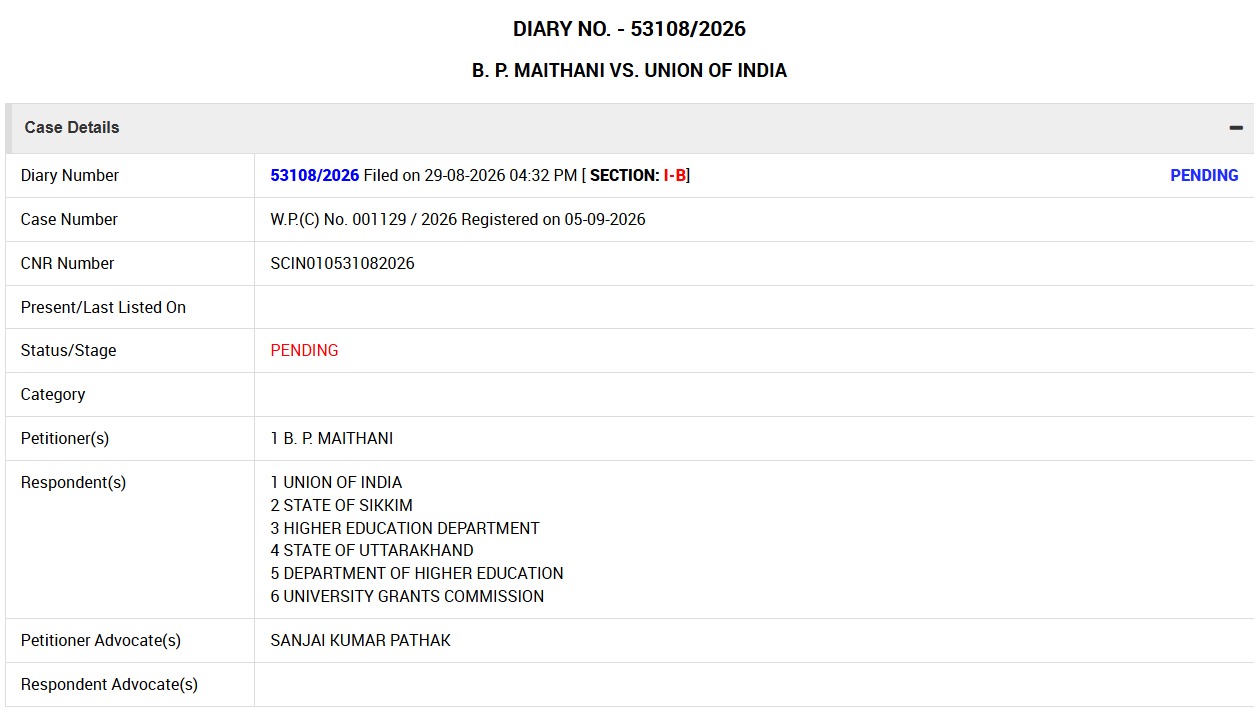
In a significant development concerning higher education governance in India, Prof. B. P. Maithani has filed a Public Interest Litigation before the Hon’ble Supreme Court of India challenging the constitutional validity of the Sikkim Private Universities (Establishment and Regulation) Act, 2025 and the Uttarakhand Private Universities Act, 2023/2024.
The writ petition has been filed under Article 32 of the Constitution of India and raises important constitutional questions concerning the legislative competence of State Legislatures, the regulatory role of the University Grants Commission (UGC), and the protection of the academic and legal interests of students enrolled in private universities. The petition was filed on 29 August 2026.
Concern Over Repeal of Individual University Acts
A central issue raised in the petition is the repeal of individual State Acts under which private universities were separately established and their subsequent inclusion under a common or “umbrella” legislation.
According to the petition, approximately 50 separate private university Acts have been repealed under the impugned legislative framework. The petitioner contends that this development may create legal and academic uncertainty for a large number of universities, students, faculty members and other stakeholders.
UGC Regulations and Requirement of Separate State Acts
The petition places particular reliance on Regulation 3.1 of the UGC (Establishment and Maintenance of Standards in Private Universities) Regulations, 2003.
The petition states that the Regulations require every private university to be established through a separate State Act and to comply with the provisions of the UGC Act, 1956. It is therefore contended that repealing individual university Acts and bringing existing universities under a common statute is inconsistent with the statutory and regulatory framework governing private universities.
The petitioner further submits that such a change may raise serious questions concerning the statutory status of universities, recognition and validity of degrees, and the academic and professional future of students.
Constitutional Division of Powers Between Centre and States
The petition raises significant questions regarding the constitutional distribution of legislative powers between Parliament and State Legislatures in the field of higher education.
It is contended that matters relating to coordination and determination of standards in higher education fall within the Union domain under Entry 66 of List I of the Seventh Schedule to the Constitution. The petitioner argues that the impugned State legislation establishes a parallel regulatory framework covering areas such as admissions, fee fixation, academic administration, governance, inspection and institutional oversight, which substantially overlap with the regulatory domain occupied by Parliament through the UGC Act, 1956 and regulations framed thereunder.
The petition also raises questions under Articles 245, 246 and 254 of the Constitution, concerning the legislative competence of the States and the relationship between State legislation and the central legal framework governing higher education.
Reliance on the Supreme Court’s Prof. Yashpal Judgment
The petition places substantial reliance on the landmark judgment of the Supreme Court in Prof. Yashpal & Others v. State of Chhattisgarh & Others.
According to the petitioner, the principles laid down in that judgment are directly relevant to the constitutional validity of the legislative mechanism adopted by the States in the present case. The petition contends that the impugned legislation needs to be examined in light of the constitutional limitations governing State legislation in the field of higher education.
The petition also refers to several other judgments of the Supreme Court, including State of T.N. v. Adhiyaman Educational & Research Institute, T.M.A. Pai Foundation v. State of Karnataka, P.A. Inamdar v. State of Maharashtra, and Modern Dental College & Research Centre v. State of Madhya Pradesh, in support of its constitutional arguments.
Students’ Interests at the Centre of the PIL
The petitioner has stated that the PIL has not been filed for any personal, institutional or private gain, but in the larger public interest and particularly to safeguard the interests of present and prospective students.
The petition states that the issues involved have a direct bearing on the academic and legal rights of a large number of students and other stakeholders associated with private universities.
The petitioner has further submitted that the issue is not confined to Sikkim and Uttarakhand. If similar legislative models are adopted by other States, they could have wider implications for the national framework governing higher education, uniformity of standards and the regulatory role of the UGC.
Interim Relief Sought Before the Supreme Court
The petition seeks interim relief in the form of a stay on the operation and enforcement of the Sikkim and Uttarakhand Acts during the pendency of the proceedings. It also seeks directions restraining the respondents from taking any action pursuant to the impugned legislation until final disposal of the writ petition.
In the main prayer, the petitioner has requested the Supreme Court to declare the impugned Acts unconstitutional, ultra vires and void, and to direct the respondents not to give effect to or implement their provisions.
A Matter of Wider Significance for Higher Education
The writ petition brings into focus important questions concerning the establishment and statutory status of private universities, institutional autonomy, the regulatory role of the UGC, the constitutional division of powers between the Union and States, and the protection of students’ academic interests.
The petitioner has emphasized the need to ensure that the regulatory framework governing higher education remains constitutionally sound, nationally consistent and capable of protecting the interests of students, faculty members and other stakeholders.
It is clarified that the above are the grounds, contentions and prayers raised by the petitioner in the writ petition. The constitutional validity of the impugned legislation is ultimately a matter for determination by the Hon’ble Supreme Court.