Department of Educational Studies, Faculty of Education, Jamia Millia Islamia organizes One-Day Training Programme on Child Rights in Collaboration with National Human Rights Commission (NHRC)

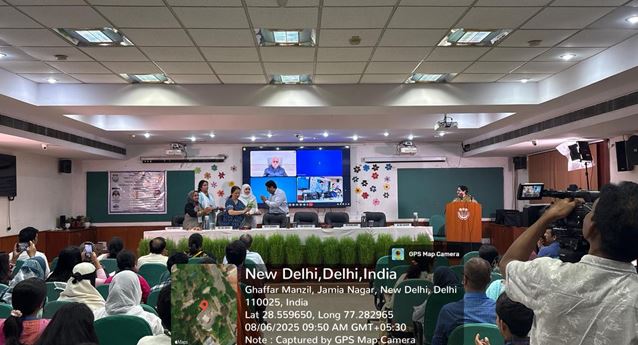
TNN News : The Department of Educational Studies, Faculty of Education, Jamia Millia Islamia, in collaboration with the National Human Rights Commission (NHRC), conducted a one-day training programme on child rights on 6th August 2025. Prof. Kaushal Kishore, Dr. Zeba Tabassum, Dr. Quazi Ferdoushi Islam and Dr. Sameer Babu M were the organizers of this significant programme.
The programme brought together experts, scholars, educators, and students to engage in critical reflections on the status, challenges, and the way forward on the key area of child rights in India. The day-long event was structured into multiple thematic sessions, culminating in a valedictory function graced by eminent dignitaries.
Justice V. Ramasubramanian, Chairperson NHRC in his keynote address, in the inaugural session, emphasized the urgent need to bridge the gap between child rights legislation and actual implementation. He drew attention to the historical neglect of children’s voices in public policy and urged institutions to move beyond symbolic gestures towards concrete, systemic interventions that respect the autonomy and dignity of children.
The Dean Faculty of Education, Prof. Jessy Abraham too shared her valuable thoughts related to child rights in the inaugural session.
The first session was delivered by Quazi Ferdoushi Islam, who provided a comprehensive introduction to human rights with a focus on constitutional provisions and international instruments such as the Universal Declaration of Human Rights. Her presentation laid a conceptual foundation for the rest of the day, linking fundamental rights with broader global discourses on justice and equity.
The second session was conducted by Neelam Singh and focused specifically on the rights of the child. She detailed the core principles of the United Nations Convention on the Rights of the Child (UNCRC) and unpacked the optional protocols that accompany the convention. Her session also included an overview of India’s legislative response, particularly the Child Labour (Prohibition and Regulation) Act, 1986, offering insights into the disconnects between global frameworks and local enforcement mechanisms.
In the third session, Charu Makkar provided an in-depth exploration of the Right of Children to Free and Compulsory Education Act, 2009. She elaborated on the operational challenges in implementing RTE in rural and urban settings and reflected critically on the exclusions that persist within the system—be it on the basis of caste, disability, gender, or socio-economic status. The session also revisited the Child Labour (Prohibition and Regulation) Act, 1986, interrogating the categories of ‘hazardous’ and ‘non-hazardous’ work and how these legal framings often fail to capture the lived realities of child workers in informal sectors.
The fourth and final session extended the discussion on child rights with a sharper legal focus. The deliberations centered on the Juvenile Justice (Care and Protection of Children) Act, 2000, particularly in the context of missing children and child protection services. The Protection of Children from Sexual Offences (POCSO) Act, 2012, was also extensively discussed. The session raised key questions around consent, criminalization, and the complex intersections between legal maturity and psychological development in children. Participants were encouraged to think beyond legal formalism and engage with the structural violence embedded in systems meant to protect.
The valedictory session marked a fitting culmination to a day of rich and layered engagements. The chief guest of the session was Ms. Bharti Ali, a distinguished development professional and social activist with over 29 years of work in the field of child and women’s rights. As Executive Director of HAQ: Centre for Child Rights and President of the Child Rights and Sustainability Trust (CRST), Ms. Ali brought immense depth and authenticity to the conversation.
She challenged the audience to rethink the tendency of applying uniform definitions of childhood across diverse social contexts. Instead, she advocated for the design of tailor-made, age-appropriate programmes that recognize intersectional realities such as caste, gender, disability, and class. Drawing on the trajectory of child rights in India, she outlined the shift from a welfare-based approach to a rights-based framework post-1990s, marked by legislative milestones such as the Juvenile Justice Act and increased recognition of children’s agency.
Following this impactful address, Dr. Sameer Babu, one of the core organizers, presented a detailed report on the proceedings of the day. He summarized each session’s content and emphasized the relevance of such trainings in capacitating future educators, researchers, and policymakers to work in child-centric, rights-affirming ways.
The day concluded with remarks by Dr. Zeba Tabassum, Assistant Professor, who thanked the NHRC, guest speakers, faculty members, student volunteers, and participants for making the event meaningful and thought-provoking. Certificates were distributed to all participants and volunteers by the dignitaries, symbolizing not just the completion of a training programme, but the beginning of a renewed commitment to uphold and advocate for the rights of children in every sphere of life.